
以下代码gitee仓库地址tgw/数据结构。
堆的概念:如果有一个关键码的集合K = {k1 ,k2 ,k3 ,k4…,kn-1 },把它的所有元素按完全二叉树的顺序存储方式存储 在一个一维数组中.
大根堆:父节点大于或等于子节点的堆
小跟堆:父节点小于或等于父节点的堆
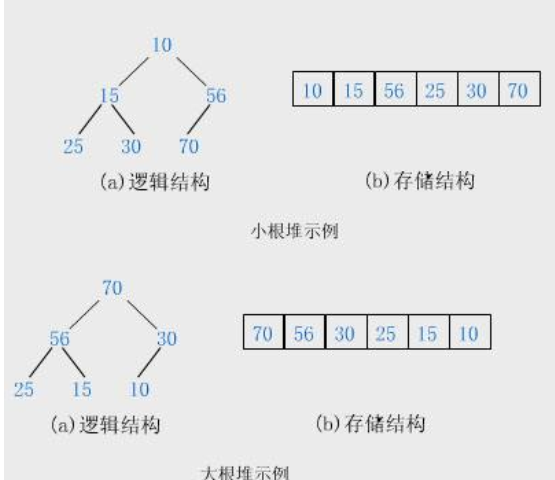
堆的实现:
首先定义:
#define _CRT_SECURE_NO_WARNINGS 1
#pragma once
#include
#include
#include
#include
#include
typedef int HPDataType;
typedef struct Heap
{
	HPDataType* a;
	int size;
	int capacity;
}HP;
void Swap(HPDataType* p1, HPDataType* p2);
void AdjustUp(HPDataType* a, int child);
void AdjustDown(HPDataType* a, int n, int parent);
void HPInit(HP* php);
void HPDestroy(HP* php);
void HPPush(HP* php, HPDataType x);
void HPPop(HP* php);
HPDataType HPTop(HP* php);
bool HPEmpty(HP* php);
结构体里面一共包括3个成员:实现的堆的数组,大小,空间
下面是具体函数的实现:
核心算法就是向上调整算法,向下调整算法:
void AdjustUp(HPDataType* a, int child)
{
// 初始条件
// 中间过程
// 结束条件
int parent = (child – 1) / 2;
//while (parent >= 0)
while (child > 0)
{
if (a[child] < a[parent])
{
Swap(&a[child], &a[parent]);
child = parent;
parent = (child – 1) / 2;
}
else
{
break;
}
}
}
void HPPush(HP* php, HPDataType x)
{
assert(php);
if (php->size == php->capacity)
{
    int newcapacity = php->capacity == 0 ? 4 : php->capacity * 2;
    HPDataType* tmp = (HPDataType*)realloc(php->a, newcapacity * sizeof(HPDataType));
    if (tmp == NULL)
    {
        perror("realloc fail");
        return;
    }

    php->a = tmp;
    php->capacity = newcapacity;
}

php->a[php->size] = x;
php->size++;

AdjustUp(php->a, php->size - 1);
}
void AdjustDown(HPDataType* a, int n, int parent)
{
// 先假设左孩子小
int child = parent * 2 + 1;
while (child < n) // child >= n说明孩子不存在,调整到叶子了
{
// 找出小的那个孩子
if (child + 1 < n && a[child + 1] < a[child])
{
++child;
}
    if (a[child] < a[parent])
    {
        Swap(&a[child], &a[parent]);
        parent = child;
        child = parent * 2 + 1;
    }
    else
    {
        break;
    }
}
}
向下调整算法示意图:
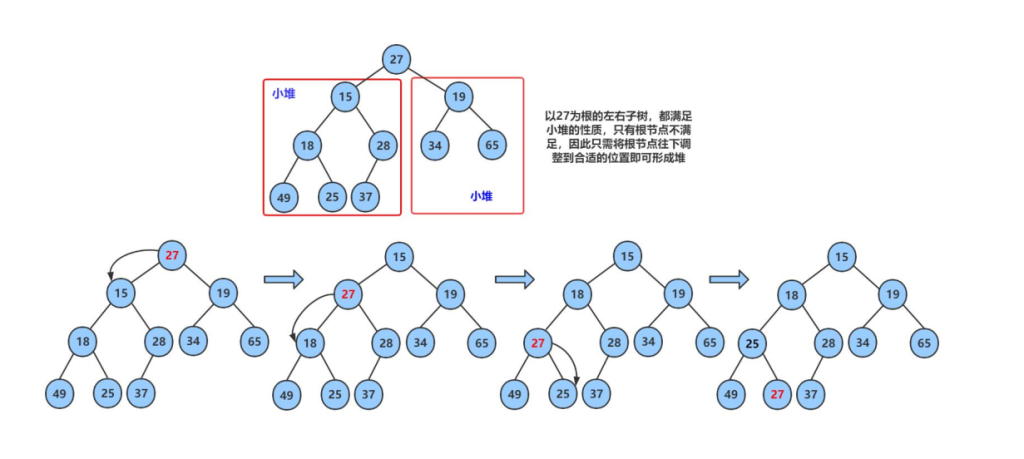
向上调整算法与其类似,主要用于插入。
今天堆的更新就到这里,明天会更新堆排序及其应用,谢谢大家的阅读,如有错误,欢迎评论区指出!!

评论
还没有任何评论,你来说两句吧!